Ibizan Health | Approved Screenings | Thyroid Labs | Health Concerns
Ibizan Health
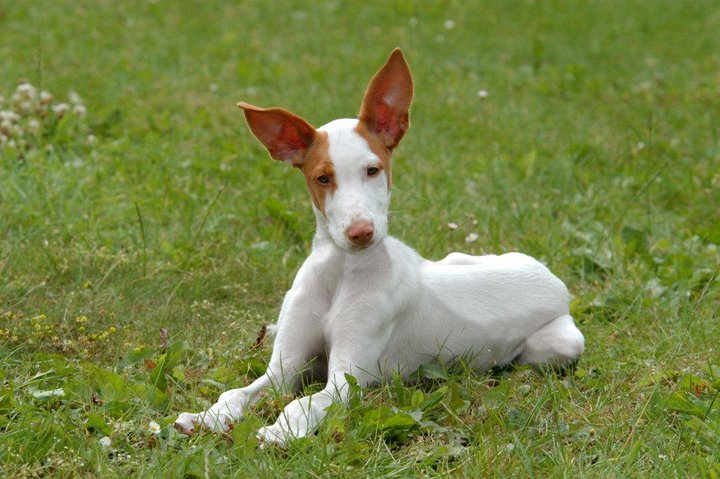 The Ibizan Hound is a hearty breed. The number of dogs that have been seriously affected by hereditary problems is small when compared to many other popular breeds.
Puppies are always adorable. How can we resist those big eyes, wiggly tails, and wet puppy kisses? While holding a soft, cuddly puppy, we imagine a loyal friend that will be around for many happy years.
Unfortunately, this is not always the reality. In any breed, hereditary health problems can be a nightmare. However, there are steps you can take to ensure you buy the healthiest puppy possible. They key is to avoid impulse buying.
Research the puppy’s pedigree and breeder before buying. Ask questions. Get answers.
Approved Screenings
The Ibizan Hound Club of the United States participates in the OFA Canine Health Information Center (CHIC) program. A dog earns CHIC certification by completing the following breed-required screenings and reporting the results to the OFA:
- Hip Dysplasia — one of the following: OFA radiographic hip evaluation, or PennHIP evaluation. Results registered with the OFA.
- Eyes — ACVO eye examination, with results registered with the OFA.
- Congenital Deafness — B.A.E.R. hearing test, with results registered with the OFA.
- Autoimmune Thyroiditis — evaluation from an OFA-approved laboratory, with results registered with the OFA (see Approved OFA Thyroid Labs below).
- Cardiac — one of the following: OFA Basic Cardiac Evaluation, or OFA Advanced Cardiac Evaluation.
A CHIC number is not a clean bill of health. For CHIC certification the results do not all have to be normal — they have to be published. The point of the programme is openness: a breeder cannot register a dog and quietly withhold a poor result. So when you are told a dog has a CHIC number, look the results up rather than assuming everything came back clear.
This list is also not everything. It is the basic screening set agreed between the OFA and the parent club. Other tests may be appropriate for an individual dog, and there are conditions in the breed for which no commonly accepted screening exists at all — several of those are described in Health Concerns below.
CHIC Numbers: The CHIC programme consolidates health screening results from multiple sources. Co-sponsored by the OFA and the AKC Canine Health Foundation, CHIC works with parent clubs to identify health screening protocols appropriate for individual breeds. Dogs tested in accordance with the parent club established requirements, that have their results registered and made available in the public domain are issued CHIC numbers. The Ibizan Hound Club of the United States requires the 5 screenings listed above in order to receive a CHIC Number. A CHIC requirement across all participating breeds is that the dog must be permanently identified via microchip or tattoo to qualify for a CHIC number.
Approved OFA Thyroid Labs
Autoimmune thyroiditis evaluations must be performed by an OFA-approved laboratory:
- Animal Health Diagnostic Center (AHDC) — Endocrinology Laboratory, Cornell University, 240 Farrier Rd., Ithaca, NY 14853. 607-253-3673
- Animal Health Laboratory — Laboratory Services Division, University of Guelph, Specimen Reception, 419 Gordon St. (NW corner Gordon/McGilvray St), Guelph, Ontario N1G 2W1, Canada. Phone 519-824-4120 x54530, Fax 519-827-0961
- Antech Diagnostics — 1111 Marcus Ave., Suite M28, Lake Success, NY 11042. 800-872-1001. Only the Lake Success, NY location is certified to process OFA thyroid panels.
- Applied BioSciences — Attn: Dr. Scott Jacques, 3837 Millican Creek Trail, College Station, TX 77845. 979-220-9823. appliedbiosciencestx@gmail.com · appliedbiosciencestx.com
- IDEXX — 1345 Denison St., Markham, Ontario L3R 5V2, Canada. 1-800-667-3411
- Michigan State University — MSU Veterinary Diagnostic Laboratory (MSU VDL), 4125 Beaumont Road Room 122, Lansing, MI 48910-8104. 517-353-1683
- Texas A&M Veterinary Medical Diagnostic Laboratory — 483 Agronomy Rd., College Station, TX 77840. 979-845-3414
Health Concerns
Statistics by Disease for Ibizan Hounds
To ensure and safeguard breed health, Reputable breeders will health test their dogs to help identify those animals that should be excluded from future breedings. Below are some of the problems that while not common, are of the most concern to breeders and owners.
Deafness: Dogs can be deaf in one or both ears. A BAER test can be performed on very young puppies (without anesthesia) to verify complete hearing. Sires and dams should be tested before breeding (though this does not ensure the pups will be free from this disorder).
Vision: OFA ECR tests should be performed on both parents before breeding. Young puppies can also be tested for certain eye disorders.
Thyroid: Autoimmune thyroiditis is the most common cause of primary hypothyroidism in dogs. The disease has variable onset, but tends to clinically manifest itself at 2 to 5 years of age. Blood tests should be performed on both parents prior to breeding. Dogs should be tested every year or two in order to be certain they have not developed the condition. Since the majority of affected dogs will have autoantibodies by 4 years of age, annual testing for the first 4 years is recommended. After that, testing every other year should suffice. CHIC website has more information.
Hip Dysplasia: Hip Dysplasia is a terrible genetic disease because of the various degrees of arthritis (also called degenerative joint disease, arthrosis, osteoarthrosis) it can eventually produce, leading to pain and debilitation.
No one can predict when or even if a dysplastic dog will start showing clinical signs of lameness due to pain. There are multiple environmental factors such as caloric intake, level of exercise, and weather that can affect the severity of clinical signs and phenotypic expression (radiographic changes).
Cardiac: Heart conditions, both congenital and adult-onset, can affect dogs, and some cardiac disease is believed to have a hereditary component. A cardiac evaluation screens breeding dogs for detectable heart abnormalities — either an OFA Basic Cardiac Evaluation (auscultation by a licensed veterinarian) or an OFA Advanced Cardiac Evaluation (echocardiogram performed by a board-certified veterinary cardiologist). Both parents should be evaluated before breeding and results registered with the OFA. As with other screenings, a clear result does not guarantee offspring will be free of heart disease.
Seizures: Causes are many, and some are thought to be hereditary in nature. No tests are available
Allergies: As in people, certain foods, pollen, topical products, insects, and other irritants are common allergies that may affect some dogs. The degree of severity varies from mild to extreme. In severe cases, veterinary treatment is required.
Chocolate: Chocolate is a concern for all dog owners. This tasty treat can be deadly to our furry friends. Here is a guide for poisoning in dogs: chocolate chart.
Bloat: What Is Bloat?
When bloat occurs, the dog’s stomach fills with air, fluid and/or food. The enlarged stomach puts pressure on other organs, can cause difficulty breathing, and eventually may decrease blood supply to a dog’s vital organs.
People often use the word “bloat” to refer to a life-threatening condition that requires immediate veterinary care known as gastric dilatation-volvulus (GDV), gastric torsion and twisted stomach. This condition can cause rapid clinical signs and death in several hours. Even with immediate treatment, approximately 25% to 40% of dogs die from this medical emergency.